
Barghe, Agosto 2025, Strabilio Festival.
Nella piccola piazza antistante la biblioteca del paese, dove sono racchiusi odore di carta e mondi di parole, si è tenuta la prima rappresentazione in Italia di ZE3MA L’AMOUR, uno spettacolo che per levatura e complessità permette di dimostrare in modo inequivocabile che il circo può essere grande arte. I linguaggi utilizzati sono molti e richiedono alcune spiegazioni. Io stesso, subito dopo la rappresentazione, mi sono sentito frastornato, scosso nel profondo, anche se per molti anni ho visto grande circo, classico e contemporaneo, in molte nazioni europee. Già il nome della compagnia, con un numero nel mezzo, risulta enigmatico. In Darija, dialetto marocchino, si utilizzano anche i numeri nella lingua scritta quando non si possono usare i caratteri arabi, perché alcuni suoni non hanno equivalenti nelle lingue neolatine. Quindi tra i monti della Valle Sabbia, in Lombardia, dove il dialetto locale è ancora molto parlato e fa parte dell’identità culturale, si è esibita una compagnia che ha scelto di utilizzare, tra i molti linguaggi, anche il dialetto della propria terra d’origine.

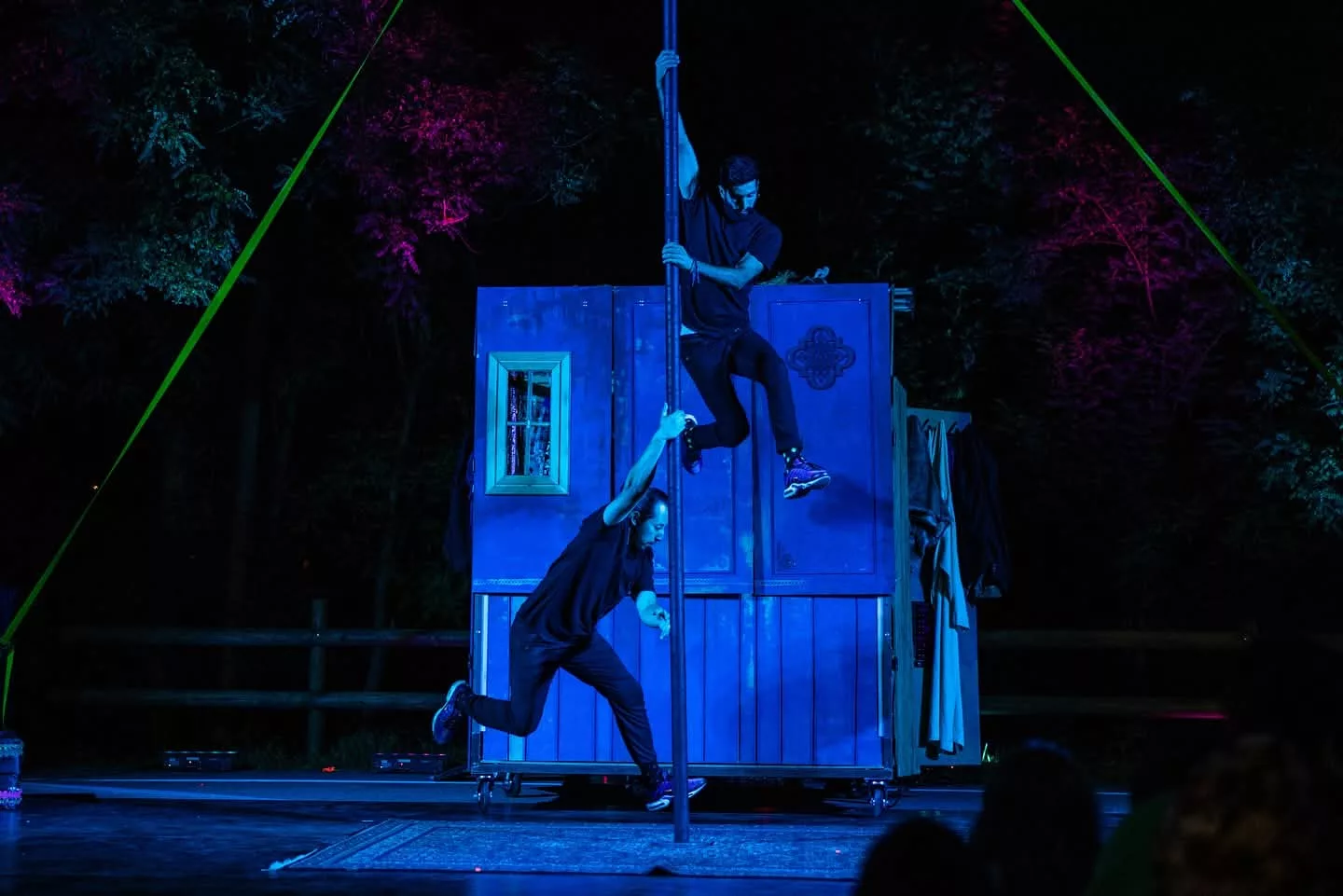
Questa però è solo una parte della semantica, e non la più importante, né la più potente. I linguaggi più penetranti sono quelli non verbali: le acrobazie, i gesti, le immagini che restano scolpite nella mente. Se torno con la memoria allo spettacolo, rivedo i due protagonisti avvinghiati in una danza acrobatica che fanno uno la parte del gendarme, che blocca, immobilizza, ammanetta, e l’altro quella dell’arrestato, che si divincola e libera. Poi i salti alla bascula, che assumono significati profondi, le cui evoluzioni sono frammiste al palo cinese, in un unico virtuosismo acrobatico, e possono essere definite “espressioniste”, come un quadro di Munch o di Schiele. Vedo un artista in piedi senza protezioni al vertice del palo cinese, con due fumogeni accesi nel gesto di creare i colori della bandiera palestinese. Vedo versare del tè nel bel mezzo dello spettacolo e offrirlo al pubblico in un gesto di amicizia e condivisione. E vedo un’anguria. Sì, proprio un’anguria, che viene colpita, e da cui viene estratto un pezzo rosso acceso, come si fosse preso il pianeta Terra e lo si fosse spaccato, per raccontarne un frammento, ma arrivando nel profondo, alla polpa viva e dolce.

È questa l’essenza vertiginosa di ZE3MA: il tentativo di raccontare profondamente un pezzo di vita con gli strumenti del circo; una vita fatta di cruente periferie parigine, di culture violate, di diritti negati. Non è uno spettacolo per chi si accontenti di estetiche vuote o gesti atletici privi di significato, bensì un regalo di Hassan Bouchontouf, Samira Boukhnous e Fahd Mellouk – questi i nomi degli artisti della compagnia – a chiunque vada alla ricerca di ricchezza culturale nell’altro da sé, anche fuori dalla propria cultura d’appartenenza, ma soprattutto a chiunque lotti per un mondo più giusto.

Barghe, August 2025, Strabilio Festival.
In the small square in front of the village library, where the scent of paper and worlds made of words are enclosed, the first performance in Italy of ZE3MA L’AMOUR was held – a show whose stature and complexity unequivocally prove that circus can be great art.
Many languages are used, and some require explanation. Even I, right after the performance, felt dazed, deeply shaken, even though I have seen great circus, both classical and contemporary, across many European countries.Even the name of the company, with a number in the middle, is enigmatic. In Darija, a Moroccan dialect, numbers are often used in writing when Arabic characters cannot be employed, as some sounds have no equivalents in Romance languages.
And so, in the mountains of Valle Sabbia, in Lombardy – where the local dialect is still widely spoken and forms part of cultural identity – a company performed that chose to include, among many languages, the dialect of their homeland.
But this is only a part of the semantics, and not the most important, nor the most powerful. The most piercing languages are the non-verbal ones: the acrobatics, the gestures, the images that remain engraved in the mind.When I recall the show, I see the two protagonists intertwined in an acrobatic dance, one playing the gendarme, who restrains, immobilizes, handcuffs; the other, the arrested one, who wriggles free and escapes. Then the jumps on the teeterboard take on profound meanings, their evolutions interwoven with the Chinese pole in a single acrobatic virtuosity, which could be called “expressionist”, like a painting by Munch or Schiele.I see an artist standing unprotected at the top of the Chinese pole, holding two lit smoke bombs in a gesture that creates the colours of the Palestinian flag.
I see tea being poured in the middle of the performance and offered to the audience – a gesture of friendship and sharing.And I see a watermelon. Yes, a watermelon, struck and from which a bright red piece is extracted, as if the Earth itself were broken open to show a fragment – reaching deep, into the sweet living flesh.
This is the dizzying essence of ZE3MA: the attempt to deeply narrate a fragment of life through the tools of circus; a life made of violent Parisian suburbs, of violated cultures, of denied rights.It is not a show for those who are content with empty aesthetics or athletic gestures without meaning. It is a gift from Hassan Bouchontouf, Samira Boukhnous, and Fahd Mellouk – the names of the artists in the company – to anyone who seeks cultural richness in the Other, beyond their own culture, but above all, to anyone who fights for a fairer world.